Wednesday, 7 July 2021

Bellarmine on Psalm 116 : Verses 1 & 2 (conclusion)

Verse 1

O praise the Lord, all ye nations: praise him, all ye people.

Laudate Dominum, omnes gentes, laudate eum, omnes populi.


As I have said, the prophet is addressing the entire Church and urging her to praise the Lord: by the word nations, as the Apostle teaches, he understands heathens (gentilism [1]) converted to the faith; he places them first because he saw the greater part of the Church gathered from the gentiles rather than the Jews. By people seem to be understood the peoples or tribes of the Jews, likewise converted to the faith, as St. Jerome notes in his Commentary on this text; in Acts iv, the Apostles explain the similar words of Psalm ii: “Why have the Gentiles raged, and the people devised vain things?”[2] - understanding nations to refer to the gentiles and peoples to refer to the Jews.


Verse 2

For his mercy is confirmed upon us: and the truth of the Lord remaineth for ever.

Quoniam confirmata est super nos misericordia ejus, et veritas Domini manet in aeternum.


The reason for praising God is: “for the mercy of the Lord is established” through the coming of the Messiah to the gentiles and the Jews. For the Church has been founded “against which the gates of Hell shall not prevail,” and the kingdom has been instituted, and shall have no end. Not only is His mercy confirmed, but also “the truth of His promises is fulfilled,” Matth. xvi, and it will not be changed in eternity.


[1] OED: The pagan or heathen world or domain. Obsolete.
[2] Why have the Gentiles raged, and the people devised vain things? Quare fremuerunt gentes, et populi meditati sunt inania? [Ps. ii 1]


Totus tuus ego sum
Et omnia mea tua sunt;
Tecum semper tutus sum:
Ad Jesum per Mariam.

Tuesday, 6 July 2021

Bellarmine on Psalm 112 : Verses 6, 7 & 8 (conclusion)

Verses 6 & 7

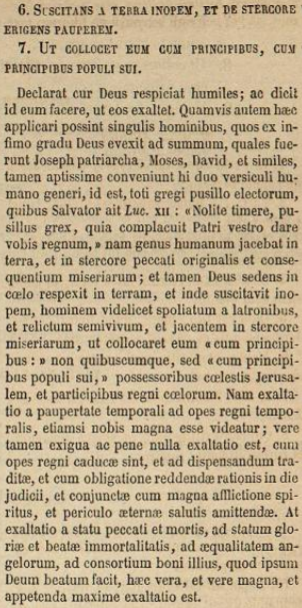
Raising up the needy from the earth, and lifting up the poor out of the dunghill: That he may place him with princes, with the princes of his people.

Suscitans a terra inopem, et de stercore erigens pauperem : ut collocet eum cum principibus, cum principibus populi sui.


He reveals why God looks upon the humble: and he says that God does this to exalt them.  Although this can be applied to those men raised up by God from the lowest depths to the heights, such as Joseph the patriarch, Moses, David and other such like, yet these two verses are most apt for the (whole) human race, that is, the whole of the little flock of the elect, to whom the Saviour says in Luke xii: “Fear not, little flock, for it hath pleased your Father to give you a kingdom,”[1] for the human race lay prostrate on the earth, on the dunghill of original sin and the miseries resulting therefrom; and yet God seated in heaven looks upon the earth, and He raises up man, despoiled by robbers and left for dead, so that He can place him “with princes:” and not with just any princes but with “the princes of his people,” the possessors of the heavenly Jerusalem who share in the heavenly kingdom. For being raised out of the temporal poverty (of this world), even if this seems a great thing to us, is in fact of little significance and scarcely counts as being raised up, since the things of the earthly kingdom are perishable, handed to us for our use, and carrying an obligation to render an account for them at the day of judgement; they are bound up with a great affliction of the spirit, and risk the loss of eternal salvation. But being raised up from the state of sin and death to the state of glory and blessed immortality, to equality with the angels, to sharing in the community of that good which makes God Himself blessed, this is the true and the truly great raising up or exaltation, which is most greatly to be sought.

[1] Fear not, little flock, for it hath pleased your Father to give you a kingdom. Nolite timere pusillus grex, quia complacuit Patri vestro dare vobis regnum. [Luke xii. 32]

Verse 8


Who maketh a barren woman to dwell in a house, the joyful mother of children.

Qui habitare facit sterilem in domo, matrem filiorum laetantem.


In the same way that the condition of being lowly and despised is (considered) a misfortune among men, so is barrenness among women. But just as God looks upon men who are humble, so that He may raise them from the lowest position up into His kingdom, so too He looks upon women who are humble, so that He may lead them from barrenness to fertility. This can be applied to several women, such as Sara, Rebecca, Rachel, Anne and others. But in a higher sense it refers to the Church assembled from the gentiles, that for a long time remained barren, but who in her old age bore numerous children, as the Apostle says in Gal. iv, taken from Isai. liv: “Rejoice, thou barren, that bearest not: break forth and cry, thou that travailest not: for many are the children of the desolate, more than of her that hath a husband.”
[1] This is relevant to the words: “Who maketh a barren woman to dwell in a house,” where the word “house” is read as referring to a family or an abundance of children, so that the sense is: Who makes the barren woman, who lives alone, dwell surrounded by her children, in a great family. This is explained by the words that follow: “the joyful mother of children.” 
This is explained by the words that follow: “the joyful mother of children;” for to dwell in a house is to be the mother of children, and by reason of this, for the woman who was sorrowful because of barrenness and loneliness to be joyful because of the multitude of her children.

[1]   For it is written: Rejoice, thou barren, that bearest not: break forth and cry, thou that travailest not: for many are the children of the desolate, more than of her that hath a husband. Scriptum est enim : Laetare sterilis, quae non paris; erumpe et clama, quae non parturis : quia multi filii desertae, magis quam ejus quae habet virum. [Gal. iv. 27]   

Totus tuus ego sum
Et omnia mea tua sunt;
Tecum semper tutus sum:
Ad Jesum per Mariam.

Monday, 5 July 2021

Bellarmine on Psalm 112 : Verses 4 & 5

Verse 4

The Lord is high above all nations; and his glory above the heavens.

Excelsus super omnes gentes Dominus, et super caelos gloria ejus.


Not only throughout the length and breadth of the world, but also at every level, is found material for the praise of God; for even if on earth there are many great princes and powerful kings, God rises far above them all; for not only is God elevated “above all nations (of the earth),” but also over all the angels of heaven, and His glory transcends all the heavens and those who dwell there. St. John Chrysostom would have these two verses hold a prophecy of the Christian Church, through it came to pass that “the name of the Lord”, known in Judea alone, should be praised “from the rising of the sun unto the going down of the same,” and all nations should be subject to Him, and in this manner “the Lord might be high above all nations.”


Verse 5

Who is as the Lord our God, who dwelleth on high: And looketh down on the low things in heaven and in earth?

Quis sicut Dominus Deus noster, qui in altis habitat, et humilia respicit in caelo et in terra?


He now praises God by reason of His wonderful kindness which, conjoined with such great sublimity, appears yet more wondrous. “Who,” he asks,  “is as the Lord our God, who dwelleth on high?” namely, in the highest heaven, and yet “He looketh down on the low things,” on men on earth below. For in this way it seems the verse has to be explained, according to the distinction drawn in Hebrew and the way the Scripture speaks; so that the words in heaven refer to the phrase dwelleth on high, and in earth refers to looketh down on the low things; especially since in Hebrew there are two contrary participles: Who is as the Lord our God exalted to those seated below, and humble to those looking from heaven and earth? The words in I Cantic. are similar: “I am black but beautiful, O ye daughters of Jerusalem, as the tents of Cedar, as the curtains of Solomon,”[1] where  as the tents of Cedar goes with I am black, and as the curtains of Solomon goes with but beautiful. By this expression is meant that God, through the excellence of His nature, has all things subject to Himself; and yet he is present in all things through his mercy, even to the most humble, and He chiefly attends to the meek and humble of heart. If this distinction is not acceptable, the verse can also be correctly explained as meaning that God, though in nature most excellent and sublime, is wont to avert His gaze from the proud and the arrogant, but willingly attends to the humble and meek; this applies in  heaven and on earth: for in heaven, abhorring the proud angels, He attends to the humble angels and leads them up to share in His glory; and on earth, despising the proud Pharaohs and Sauls and others like them, He attends to Moses, David, and other men meek and humble of heart. But in a higher and prophetic sense, these words can be understood as meaning that God, seated in heaven, has not been neglectful towards (the humble in) the human race cast down on earth.

[1] I am black but beautiful, O ye daughters of Jerusalem, as the tents of Cedar, as the curtains of Solomon…. Nigra sum, sed formosa, filiae Jerusalem, sicut tabernacula Cedar, sicut pelles Salomonis. [I Cantic. 4]


Totus tuus ego sum
Et omnia mea tua sunt;
Tecum semper tutus sum:
Ad Jesum per Mariam.

Sunday, 4 July 2021

Bellarmine on Psalm 112 : Verses 2 & 3

Verses 2 & 3

Blessed be the name of the Lord, from henceforth now and for ever. From the rising of the sun unto the going down of the same, the name of the Lord is worthy of praise.

Sit nomen Domini benedictum ex hoc nunc et usque in saeculum. A solis ortu usque ad occasum laudabile nomen Domini.


He declares the way in which the servants of God should praise the name of the Lord, and he says it should be, at he least, with affection and desire, since we creeping creatures of the earth unfortunately do not know how to praise as we should. Therefore speak, he says, with love from the bottom of your heart: “Blessed be the name of the Lord, from henceforth now,” at present, “and for ever,” to all future generations, so that there will never be an end to His praises; or rather, “from henceforth now,” begin ye to praise,and praise ye “for ever,” that is, offer praise always, whether in prosperity or adversity, whether in this life in that to come, let there be praise always on your lips, and with St. Job, say without ceasing: “Blessed be the name of the Lord.”[1] He reveals in this and the following verses material for praising God, and he says this material in praise of God is found everywhere, since all things are full of His great works and wonders, which when diligently considered reflect praises on their maker. “From the rising of the sun unto the going down of the same,” that is, throughout the whole extent of the world, from the beginning to the end, “the name of the Lord is worthy of praise,” on account of His works, which fill every corner of the world.

[1] And said: Naked came I out of my mother's womb, and naked shall I return thither: the Lord gave, and the Lord hath taken away: as it hath pleased the Lord so is it done: blessed be the name of the Lord. et dixit : Nudus egressus sum de utero matris meae, et nudus revertar illuc. Dominus dedit, Dominus abstulit; sicut Domino placuit, ita factum est. Sit nomen Domini benedictum. [Job Ii. 1]


Totus tuus ego sum
Et omnia mea tua sunt;
Tecum semper tutus sum:
Ad Jesum per Mariam.


Saturday, 3 July 2021

Bellarmine on Psalm 112 : Title, theme & Verse 1

Title and subject matter

Titulus et argumentum

Alleluia


This short and simple Psalm urges worshippers of God to praise Him because He is almighty and, although He is the Most High, yet He does not refuse to turn His gaze upon us, and to bestow on us His numerous blessings.

Verse 1

Praise the Lord, ye children: praise ye the name of the Lord.

Laudate, pueri, Dominum, laudate nomen Domini.


The word children is to be understood as referring to the servants of God, who worship Him soley and unconditionally: for the Greek word παἳδες, and the Latin pueri, are commonly used for servants and children, but the Hebrew word means nothing but servant; and this appears more clearly from the fact that in Hebrew the word Domini / of the Lord, is  in the genitive case: Praise ye, O servants of the Lord, praise ye the name of the Lord. In fact, there is a great affinity between servants and children, so that not unjustly are servants said to be children and children servants, since servants should suffer to be ruled by their masters and children are ruled by their elders; hence Blessed Paul says to the Galatians: “Now I say, as long as the heir is a child, he differeth nothing from a servant.”[1]  We are reminded therefore by the word children that God’s servants should be simple and pure, and respond unhesitatingly to God’s will. “Praise the Lord, ye children: praise ye the name of the Lord,” that is, O all ye who are servants of God, serve ye Him chiefly in this, that you reflect with a pure mind on the greatness of your Lord and that, with all the love of your heart, you praise His name, which is to say His might and His infinite glory. There is a similar exhortation in Psalm CXXXIV: “Praise ye the name of the Lord: O you his servants, praise the Lord.”[2]

[1] Now I say, as long as the heir is a child, he differeth nothing from a servant, though he be lord of all; Dico autem : quanto tempore haeres parvulus est, nihil differt a servo, cum sit dominus omnium : [Galat. iv. 1]
[2] Praise ye the name of the Lord: O you his servants, praise the Lord: Alleluja. Laudate nomen Dominum; laudate, servi, Dominum : [Ps. CXXXIII. 1]


Totus tuus ego sum
Et omnia mea tua sunt;
Tecum semper tutus sum:
Ad Jesum per Mariam.


Friday, 2 July 2021

Bellarmine on Psalm 109 : Verse 8 (conclusion)

Verse 8

He shall drink of the torrent in the way: therefore shall he lift up the head.

de torrente in via bibet; propterea exaltabit caput.


The majority of the ancients explain this last verse as being about Christ’s humility in the flesh and His exaltation in heavenly glory; this applies both to those who read the previous verses as being about Christ and to those who read them as being about the Father. It is in fact a surprise to find some more modern commentators taking a different view. David gives a reason why Christ’s power is so great that he is able to break kings, judge nations, fill ruins and crush heads; and he says: “He shall drink of the torrent in the way: therefore shall he lift up the head,” as though he were to say with the Apostle: “He humbled himself, becoming obedient unto death, even to the death of the cross. For which cause God also hath exalted him, and hath given him a name which is above all names.”[1] He calls the course of human affairs a torrent: for just as a torrent flows with great force and noise, and proceeds in turbulence and confusion, then soon after ceases, and leaves not a wrack behind: so it is with human affairs in this short period of mortality; for all things pass, and with much turbulence and confusion: great battles and conflicts between peoples and nations are often heard of, as in the time of Alexander the Great and afterward of Caesar and of others like them. But shortly after, they come to an end, both they themselves and their successors, and traces of their power can scarcely be found. Through His incarnation, the Son of Man came down into this torrent, and “in the way,” that is, during the course of His mortal and transitory life, “He drank the water,” the turbid water of this “torrent,” He bore the distress of our mortality, indeed He plunged into the depths of the torrent by His passion, and so He will not have drunk water for His refreshment and pleasure but He will have drunk water most noxious, as they do who sink into watery depths, as Psalm LXVIII: “Save me, O God: for the waters are come in even unto my soul. I stick fast in the mire of the deep: and there is no sure standing. I am come into the depth of the sea: and a tempest hath overwhelmed me.”[1] By the merit of such great humility willingly taken on for the glory of the Father, and for the salvation of mankind, He has now lifted His head , ascending to heaven, and being seated at the right hand of the Father, established as judge of the living and the dead. Others read the verb in the preterite, he hath drunk;  but the Hebrew and Greek have the future, He shall drink: hence our common reading matches the original texts.

[1] He humbled himself, becoming obedient unto death, even to the death of the cross. For which cause God also hath exalted him, and hath given him a name which is above all names: Humiliavit semetipsum factus obediens usque ad mortem, mortem autem crucis. Propter quod et Deus exaltavit illum, et donavit illi nomen, quod est super omne nomen :  [Philipp. ii. 8-9]
[2] SAVE me, O God: for the waters are come in even unto my soul. I stick fast in the mire of the deep: and there is no sure standing. I am come into the depth of the sea: and a tempest hath overwhelmed me. Salvum me fac, Deus, quoniam intraverunt aquae usque ad animam meam. Infixus sum in limo profundi et non est substantia. Veni in altitudinem maris; et tempestas demersit me. [Ps. LXVIII 1-2]


Totus tuus ego sum
Et omnia mea tua sunt;
Tecum semper tutus sum:
Ad Jesum per Mariam.


Thursday, 1 July 2021

Bellarmine on Psalm 109 : Verse 7

Verse 7

He shall judge among nations, he shall fill ruins: he shall crush the heads in the land of the many.

Judicabit in nationibus; implebit ruinas, conquassabit capita in terra multorum.


He has said what Christ will do to His enemies at the present time, the kings and the princes of the earth: now he adds what He will do towards all His enemies at the last day: “He shall judge,” the Prophet says, “among nations,” that is, He who at this time crushes the attacks of kings, and preserves His Church in a time of persecutions, shall afterwards at the end of the world “judge among nations,” that is, He will pronounce His judgement against all nations; and, all the wicked having been condemned, “he shall fill ruins,” that is, He will bring about their total elimination, He will complete the destruction of the wicked. From the Hebrew, St. Jerome’s translation is: He will fill the pits of hell, which is also true, for then shall be filled the lowermost pits, all the wicked men and demons being thrust down and coming to their end therein: and in this way “He shall crush the heads in the land of the many,” that is, He will humble and crush the proud, those who now march boastfully with heads held high against Him, He will on that day trample on their pride, and He will reveal their feebleness to the whole world, and He will confound them and render them contemptible: and this is what it will mean to crush and grind down their heads. He says “in the land of the many,” because on earth the truly humble and pious are very few  compared to the proud and the wicked, who are nearly without number. In Hebrew it has in much of the earth, that is, in a great part of the earth; but the sense is the same, whether it is said that many are the proud who are found on earth, or the proud occupy much of the earth. St. Augustine explains all these things as referring to the present time, and having a good effect, so that to fill ruins is to rebuild what has fallen, and to crush heads is to humble a person unto salvation through contrition; this is a pious and useful interpretation, but mystical: for Theodoret, Euthymius and others commonly interpret this literally as being about the final judgement.

Totus tuus ego sum
Et omnia mea tua sunt;
Tecum semper tutus sum:
Ad Jesum per Mariam.