Friday, 13 August 2021

Bellarmine on Psalm 125 : Verse 6 (conclusion)

Verse 6


Blessed is the man that hath filled the desire with them; he shall not be confounded when he shall speak to his enemies in the gate.

Beatus vir qui implevit desiderium suum ex ipsis : non confundetur cum loquetur inimicis suis in porta.


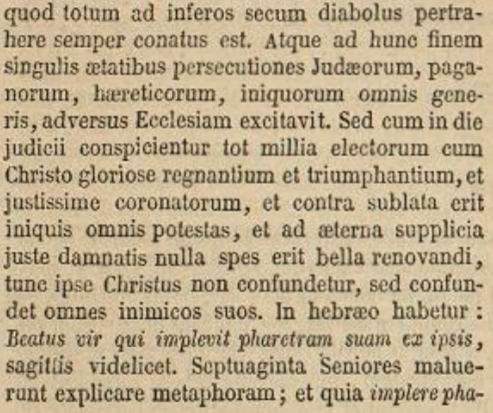
The Psalm is concluded with an epiphonema,[1] calling out to the Lord Christ Himself: “Blessed is the man that hath filled the desire with them,” that is, truly happy is He, namely Christ, “ that hath filled the desire with them,” (His) children, for He hath brought His desire to fulfilment, of living the salvation and glory of His children, for whom He did and suffered so many things, and so “ he shall not be confounded when he shall speak to his enemies in the gate,” that is, at the last judgement, which will be held in an exceptionally spacious gateway, that is, with the whole world assembled, “ he shall not be confounded when he shall speak to his enemies,” demons and wicked men; he will confound them and convict them of injustice and foolishness : for the whole of Christ’s strife with the devil and his minions, from the 
beginning of the world to its end, concerned the salvation of the human race, which the devil has always been trying to drag in its entirety down into hell with himself. And to this end, in every age, he has stirred up persecutions against the Church, by the Jews, the pagans, heretics and wicked men of every stripe. But when, at the day of judgement, so many thousands of the elect are seen reigning gloriously and in triumph with Christ, and crowned most justly, all power will be removed from them, and the wicked, justly condemned to eternal torments, will have no 
hope of renewing the war, for Christ will not be confounded but will Himself confound all his enemies. In Hebrew, it has: Blessed is the man that hath filled his quiver with them, that is, with arrows. The Septuagint Elders preferred to explain the metaphor; and because to fill a quiver with arrows means to fill a house with most valiant sons, they preferred to translate the words thus: “Blessed is the man that hath filled the desire with them,” that is, by prayer and desire he has filled his house with the finest and most stalwart sons. In the sentence, he shall not be confounded when he shall speak to his enemies, the Hebrew and Greek has the verbs in the plural, they shall not be confounded when they shall speak. It is probable that the number was changed in a particular text trough an error of the scribes. When St. Jerome and St. Augustine in their Commentarii read the text in the singular, but St. Hilary and St. John Chrysostom read it in the plural, as  they shall not be confounded 
when they shall speak, it must be that the Greek and the Latin texts were different; but either reading is true : for it is truly said of Christ : “he shall not be confounded  when he shall speak to his enemies in the gate;” and it is also truly said of the chosen children of God : “ they shall not be confounded when they shall speak to their enemies in the gate,” since it is written: “Then shall the just stand with great constancy against those that have afflicted them.”[2] We have interpreted the words in the gate as in the last judgement, as we said in the explanation of Psalm CXXI, among the Hebrews, the multitude of the people used to gather in the gates of the cities; moreover, St. Augustine teaches in his commentary on this verse that to speak in the gates means to speak publicly, just as to speak in the bedchamber means to speak in a hidden and secret manner. Since, therefore, the last judgement will take place openly and publicly, in the sight of all angels and men, it is rightly said to take place in the gates, and Christ and His elect are rightly said to speak to their enemies in the gate.

[1] An exclamatory sentence or striking reflection, which sums up or concludes a discourse or a passage in the discourse. OED. 
[2] Then shall the just stand with great constancy against those that have afflicted them, and taken away their labours. Tunc stabunt justi in magna constantia adversus eos qui se angustiaverunt, et qui abstulerunt labores eorum. [Wisdom v 1]

Totus tuus ego sum
Et omnia mea tua sunt;
Tecum semper tutus sum:
Ad Jesum per Mariam.

Thursday, 12 August 2021

Bellarmine on Psalm 126 : Verse 5

Verse 5

As arrows in the hand of the mighty, so the children of them that have been shaken.

Sicut sagittae in manu potentis, ita filii excussorum.


The prophet in these words declares the power of the children of Christ who are His inheritance and reward, and he says they are extremely powerful, like arrows in the hand of a very strong man which are loosed with maximum force and can penetrate everything; he is speaking however of the spiritual power of the servants of Christ which is no different in its action than its endurance; for just as thunder and lightning cause terror, they convert infidels to the faith and sinners to penitence, by the power of their preaching, by the brightness of their sanctity and by the power of their miracles; and when, struggling on behalf of their faith and piety, they endure unto death torments of every description through incredible patience and fortitude, what are these if not “arrows in the hand of the mighty?” But why are these children (who are) so strong described as the children of them that have been shaken? Because they are the children of outcast and rejected men, namely, the children of the Prophets and the Apostles; for the Apostle says of the Prophets in Hebrews xi: “Others had trial of mockeries and stripes, moreover also of bands and prisons. They were stoned, they were cut asunder, they were tempted, they were put to death by the sword, they wandered about in sheepskins, in goatskins, being in want, distressed, afflicted: of whom the world was not worthy.”[1]  Paul says the same of the Apostles in I Cor, iv: “ For I think 
that God hath set forth us apostles, the last, as it were men appointed to death: we are made a spectacle to the world, and to angels, and to men. ... Even unto this hour we both hunger and thirst, and are naked, and are buffeted, and have no fixed abode; And we labour, working with our own hands: we are reviled, and we bless; we are persecuted, and we suffer it. We are blasphemed, and we entreat; we are made as the refuse of this world, the off-scouring of all even until now.”[2] And yet these outcasts and rejects were the bravest and triumphed miraculously over the world and the demons. All the elect are the children of these, who like arrows in the hand of a mighty warrior have wounded and conquered the enemy. I know that this text has been interpreted differently by the ancients and by more recent commentators, but, as I have said on many occasions, each one will find an abundance in his own interpretation provided there is no danger to the faith. It is of no great matter that St. Jerome translates the Hebrew as filii juventutis / children from the age of youth whereas we have the children of them that have been shaken, and he 
defends his translation in his epistle ad Marcellam, on the question of this Psalm : for the Hebrew word can mean either youth or refer to them that have been shaken; hence the Septuagint and our Vulgate edition do not contradict the original text. Nor do we reprove the intelligence of St. Jerome, since the chosen are (in one sense) the children of them that have been shaken, as the children of the Prophets and the Apostles considered by the world as reprobates, and (in another sense) the children of youth, because they are made young by a process of regeneration and renewal, and as such they are eager, strong and prepared for war against their spiritual enemies. But in the time to come, and especially in the day of resurrection and the final judgement, it will appear most clearly how powerful are these children of them that have been shaken, who will then through a glorious resurrection be the true children of youth, because their youth “shall be renewed like the eagle's:”[3]  “Then shall the just stand with great constancy against those that have afflicted them,”[4] as it says in Wisdom v;[5] and their adversaries, “These seeing it, shall be troubled with terrible fear, and shall be amazed at the suddenness of their unexpected salvation.  Saying within themselves, repenting, and groaning for anguish of spirit: These are they, whom we had some time in derision, and for a parable of reproach etc. And in Psalm CXLIX: “two-edged swords in their hands:To execute vengeance upon the nations, chastisements among the people: To bind their kings with fetters, and their nobles with manacles of iron. To execute upon them the judgment that is written: this glory is to all his saints.”[6]

[1] And others had trial of mockeries and stripes, moreover also of bands and prisons. They were stoned, they were cut asunder, they were tempted, they were put to death by the sword, they wandered about in sheepskins, in goatskins, being in want, distressed, afflicted: Of whom the world was not worthy; wandering in deserts, in mountains, and in dens, and in caves of the earth. Alii vero ludibria, et verbera experti, insuper et vincula, et carceres : lapidati sunt, secti sunt, tentati sunt, in occisione gladii mortui sunt, circuierunt in melotis, in pellibus caprinis, egentes, angustiati, afflicti : quibus dignus non erat mundus : in solitudinibus errantes, in montibus, in speluncis, et in cavernis terrae. [Hebrews xi 36-38]
[2] I Cor. iv 9-13]
[3] Who satisfieth thy desire with good things: thy youth shall be renewed like the eagle's. qui replet in bonis desiderium tuum : renovabitur ut aquilae juventus tua. [Ps. cii 5]
[4] Then shall the just stand with great constancy against those that have afflicted them, and taken away their labours. Tunc stabunt justi in magna constantia adversus eos qui se angustiaverunt, et qui abstulerunt labores eorum. [Wisdom v 1]
[5] These seeing it, shall be troubled with terrible fear, and shall be amazed at the suddenness of their unexpected salvation.  Saying within themselves, repenting, and groaning for anguish of spirit: These are they, whom we had some time in derision, and for a parable of reproach. Videntes turbabuntur timore horribili, et mirabuntur in subitatione insperatae salutis; dicentes intra se, poenitentiam agentes, et prae angustia spiritus gementes : Hi sunt quos habuimus aliquando in derisum, et in similitudinem improperii. [Wisdom v 2-3]
[6] The high praise of God shall be in their mouth: and two-edged swords in their hands:To execute vengeance upon the nations, chastisements among the people: To bind their kings with fetters, and their nobles with manacles of iron. To execute upon them the judgment that is written: this glory is to all his saints. Alleluia.  Exaltationes Dei in gutture eorum : et gladii ancipites in manibus eorum : ad faciendam vindictam in nationibus, increpationes in populis; ad alligandos reges eorum in compedibus, et nobiles eorum in manicis ferreis; ut faciant in eis judicium conscriptum : gloria haec est omnibus sanctis ejus. Alleluja. [Ps cxlix 6-9]


Totus tuus ego sum
Et omnia mea tua sunt;
Tecum semper tutus sum:
Ad Jesum per Mariam.

Wednesday, 11 August 2021

Bellarmine on Psalm 126 : Verse 4

Verse 4

When he shall give sleep to his beloved, Behold the inheritance of the Lord are children: the reward, the fruit of the womb.

Cum dederit dilectis suis somnum, ecce haereditas Domini, filii; merces, fructus ventris.


After this exhortation and warning, the prophet adds a consolation, prophesying that it would come to pass after these tribulations that God will give peace and rest to His people; and that the children of Israel would be God’s inheritance, and they would be most powerful and most strong , so that they would never thereafter suffer anything from their enemies; this Prophecy looks to the new people, that is, the Church of Christ, of whom the temple and the city of Jerusalem were types. For, as St. Augustine shows in chapter xlv of book xviii in his City of God, after the restoration of the temple, everything became worse for the Jews, until the city was once more destroyed through Vespasian and Titus, and the temple was burned down. He says therefore: “When he shall give sleep to his beloved,” that is, when the Lord shall have given peace and rest to His people, sending them the true Solomon, who will found and extend the true temple, that is, His Church, and He will also subject all those rulers of the earth to it. “ Behold the inheritance of the Lord, the reward, the fruit of the womb,” that is, behold it will appear that the inheritance of the Lord will be numerous children, as it says in Psalm II: “Ask of me, and I will give thee the Gentiles for thy inheritance, and the utmost parts of the earth for thy possession;”[1] and “the reward” of Christ the Lord will be “ the fruit of the womb,” namely numerous children, as it says in Isai. LIII: “If he shall lay down his life for sin, he shall see a long-lived seed.”[2] For, as we have often shown, the same idea is in the Psalms frequently repeated twice. And so the same is 
meant by  the inheritance of the Lord and the reward, the fruit of the womb, that is, the inheritance of Christ the Lord and the reward will be numerous children, who are nothing other than the fruit of the the womb. This explanation conforms to the Hebrew text where the word fruit is in the nominative and not the genitive; but in the Greek edition the word fruit is in the genitive, and so according to the Greek codex the sense will be, the multitude of children will be the inheritance of the Lord and the reward of Christ, who was truly and properly the fruit of the womb, since he had His origin not from a man but from the Virgin alone; and this is perhaps the truer explanation since the Hebrew word can, if the points are changed, be read in the genitive but the Greek word cannot be read in the nominative. Hence, if all the codices are to be harmonised, this second interpretation may be preferred. For if the Psalm is explained according to the higher sense, in this verse is prophesied the happiness of the heavenly Jerusalem, which awaits those who, after the temporary sleep of death, have hastened with steps of love and faith to go up to their eternal homeland. He therefore says: “When he shall give sleep to his beloved,” that is, when after various labours and struggles, God shall give to all his beloved, the leaders who built up the Church as well as the ordinary faithful who built up a home for themselves through their good works, the sleep of a blessed death, “Behold the inheritance of the Lord are children: the reward, the fruit of the womb,” that is, then shall appear on the day of the last judgement that the children of God are the inheritance of that same God, because then the beloved will attain eternal salvation and they will pass over into the eternal possession and inheritance of God; and these same children will be the reward of Christ, who is the “fruit of the womb,” because the salvation of the elect is the reward of Christ; for He is the one who earned grace and glory for his beloved by suffering and dying. It is not of great significance that the Hebrew reads as thus will he give sleep  to his beloved, instead of what we have in the Greek and Latin versions, When he shall give sleep to his beloved;  for the Hebrew particle means many things, thus, truly, then, etc. And so it can be translated, then shall he give, that is, after those tribulations he will give, and the sense remains the same; but the words to his beloved (sing.) can be read as to his beloved (plural); and this is how the Septuagint and St. Jerome read the text; they had codices without the points that the Rabbis added later; and if of necessity it were to be read as to his beloved (singular), we would explain this as meaning to each one of his beloved, or to his beloved people, which is the same as what we have, to his beloved (plural). 

[1] Ask of me, and I will give thee the Gentiles for thy inheritance, and the utmost parts of the earth for thy possession. Postula a me, et dabo tibi gentes haereditatem tuam, et possessionem tuam terminos terrae. [Ps. II 8]
[2] And the Lord was pleased to bruise him in infirmity: if he shall lay down his life for sin, he shall see a long-lived seed, and the will of the Lord shall be prosperous in his hand. Et Dominus voluit conterere eum in infirmitate. Si posuerit pro peccato animam suam, videbit semen longaevum, et voluntas Domini in manu ejus dirigetur. [Ps. LIII 10]

Totus tuus ego sum
Et omnia mea tua sunt;
Tecum semper tutus sum:
Ad Jesum per Mariam.


Monday, 9 August 2021

Bellarmine on Psalm 126 : Verse 3

Verse 3

It is vain for you to rise before light, rise ye after you have sitten, you that eat the bread of sorrow. 

Vanum est vobis ante lucem surgere : surgite postquam sederitis, qui manducatis panem doloris.


The children of Israel, while they were experiencing their concerns, began the work of building before daylight on account of their great anxiety; the Holy Spirit warned them that it would profit them nothing if they began to work before daylight, unless the Lord were present with them; but if they accepted the Lord’s help and placed their hope in Him, their work would proceed prosperously, even if they girded themselves for work after necessary sleep, and after the sun had risen. “It is vain,” he says, “for you to rise before light” in order to proceed with the building work; here is to be understood: Unless the Lord build the house, or “keep the city;” and therefore trusting in the Lord and calling upon Him continually, “rise ye after you have sitten,” that is, after a necessary night’s sleep, rise to the task, “you that eat the bread of sorrow,” that is, you who now live in anguish and under the oppression of continuous harassment from enemies. But in the sense intended more by the Holy Spirit, the heads of the Church are instructed, as also are all the faithful, whether as communities or individuals, not to place their trust in the works more than in prayer; but they should imitate the Lord who during the night keep watch in prayer, as is written in Luke vi: “He passed the whole night in the prayer of God”[1] and in the daytime he preached and confirmed His speech with miracles; as also the Apostles are to be imitated who say in Acts vi: “We will give ourselves continually to prayer, and to the ministry of the word.”[2] “It is vain,” he says, “for you to rise before light,” that is, to use all your time in 
building and guarding (your work). “Rise ye after you have sitten,” that is, rise to your task after you have slept, leaving your rest of prayer and contemplation. “You that eat the bread of sorrow,” that is, you who on account of your longing for your heavenly home continually groan and say: “My tears have been my bread day and night, whilst it is said to me daily: Where is thy God?”[3] Those who love ardently, when they cannot enjoy the presence of the object of their love, are sustained in the meantime by longing and groaning, and in this way tears become bread for them day and night, that is, in daytime meals and in supper by night. In Hebrew, it does not have surgite / rise ye; but the Septuagint translators seem to have read this slightly differently than what we have in our codices; where the Hebrew word is found which means to rise, the translators seem to have read a word translated as surgite / rise ye; and although Euthymius reads the Greek codex as to rise, the ancient Fathers read  surgite / rise ye, as do St. Jerome and St. Augustine in his Commentary. Finally, St. Hilary reads it in this way too and he, as St. Jerome writes in his book De Scriptoribus Ecclestiacis, copied Origen in his explanation of the Psalms. It is certain that Origen and other ancient Greek and Latin writers had codices that were more correct than the one Euthymius had, unless Euthymius also read it as surgite / rise ye but thought he should correct the text, by changing one letter : for ἐγεἱρεσθαι is to rise, and  ἐγεἱρεσθε is rise ye.

[1] And it came to pass in those days, that he went out into a mountain to pray, and he passed the whole night in the prayer of God. Factum est autem in illis diebus, exiit in montem orare, et erat pernoctans in oratione Dei. [Luke vi 12]
[2] But we will give ourselves continually to prayer, and to the ministry of the word. Nos vero orationi, et ministerio verbi instantes erimus. [Acts vi 4]
[3] My tears have been my bread day and night, whilst it is said to me daily: Where is thy God? Fuerunt mihi lacrimae meae panes die ac nocte, dum dicitur mihi quotidie : Ubi est Deus tuus? [Psalm xlii 4]


Totus tuus ego sum
Et omnia mea tua sunt;
Tecum semper tutus sum:
Ad Jesum per Mariam.

Bellarmine on Psalm 126 : Verse 2

Verse 2


Unless the Lord keep the city, he watcheth in vain that keepeth it.

Nisi Dominus custodierit civitatem, frustra vigilat qui custodit eam.


When the city of Jerusalem was being built after the captivity, it was guarded at the same time it was built, as witnessed in the Scriptures, see book II of Esdras. For the gentiles who were round about tried not only to obstruct the building but also to demolish what had been constructed : and so the children of Israel held a sword in one hand whilst with the other they did the building work; and many of them deployed on protection duty had to keep continual watch. Nevertheless, they would have gained by so many nothing watches unless the Lord had wanted to guard the city. This also applies to the leaders of the Church, who are obliged to build up the Church and at the same time to guard it : for we dwell in the midst of enemies who hate nothing more than the extension of the Church. Although it is given to the bishops to occupy a higher position in the Church, as though in a watch-tower where they can be on the lookout for all things and guard their people, yet they cannot penetrate into men’s hearts and cannot be everywhere with everyone; therefore “Unless the Lord keep the city, he watcheth in vain that keepeth it.” The same thing is wont to befall us, when through our good works we are building a house for ourselves, enemies are never absent who by various temptations strive to destroy the incomplete building; hence the Apostle arms us, writing in chapter vi of Ephesians where he says: “Take unto you the armour of God, that you may be able to resist in the evil day;”[1] and further on, “In all things taking the shield of faith, wherewith you may be able to extinguish all the fiery darts of the most wicked one.”[2] But unless the Lord is present with us and unless he guards us when we frequently slumber and fights on our behalf, all our work will be in vain.

[1] Therefore take unto you the armour of God, that you may be able to resist in the evil day, and to stand in all things perfect. Propterea accipite armaturam Dei, ut possitis resistere in die malo, et in omnibus perfeci stare. [Ephes. vi 13]
[2] In all things taking the shield of faith, wherewith you may be able to extinguish all the fiery darts of the most wicked one. in omnibus sumentes scutum fidei, in quo possitis omnia tela nequissimi ignea extinguere : [Ephes. vi 13]


Totus tuus ego sum
Et omnia mea tua sunt;
Tecum semper tutus sum:
Ad Jesum per Mariam.

Saturday, 7 August 2021

Bellarmine on Psalm 126 : Verse 1

Verse 1

Unless the Lord build the house, they labour in vain that build it.

Nisi Dominus aedificaverit domum, in vanum laboraverunt qui aedificant eam.


These words are said to the Jews building the house of God, that is the temple, when the work was not proceeding very well because of the obstructions of the neighbouring gentiles, as is written in Book I of Esdras. They are warned that they should reflect on the fact that men’s works are of no value unless God, the primary builder, is present; and so they should not only work with their hands but they should invoke God in their heart and in the words of their mouth, placing their chief trust in His assistance. “Unless the Lord build the house,” that is, unless the Lord, invoked with trust, is present in their works, “they labour in vain that build it,” that is, all their labour is and will be completed in vain. These same words are also addressed to the heads of the Church who, through preaching the word of God, endeavour to convert men to God, and to incorporate them in building up God’s temple, that is, the Church, as it says in I Corinth. iii: “You are God's building,”[1] and again : “As a wise architect, I have laid the foundation; and another buildeth thereon;”[2] but unless the chief architect is present, who said in Matthew xvi: “Upon this rock I will build my church,”[3] men build in vain, and teachers preach the word of God in vain, for the Lord says : “Without me you can do nothing.”[4] Finally, these same words are addressed to each on of us, who ought to build a home for ourselves in heaven, through acts of faith, hope and charity. for the house of God, as St. Augustine says in serm. 22 De Verbis Apostoli, is founded on faith, is built on hope and is completed in love, and no-one is admitted into the heavenly homeland who has not first prepared such a home. But this house is built more through prayers and lamentations than through building works, because : “Not that we are sufficient to think any thing of ourselves.”[5] 

[1] For we are God's coadjutors: you are God's husbandry; you are God's building. Dei enim sumus adjutores : Dei agricultura estis, Dei aedificatio estis. [I Corinth. iii 9]
[2] According to the grace of God that is given to me, as a wise architect, I have laid the foundation; and another buildeth thereon. But let every man take heed how he buildeth thereupon. Secundum gratiam Dei, quae data est mihi, ut sapiens architectus fundamentum posui : alius autem superaedificat. Unusquisque autem videat quomodo superaedificet. [I Corinth. iii 10]
[3] And I say to thee: That thou art Peter; and upon this rock I will build my church, and the gates of hell shall not prevail against it. Et ego dico tibi, quia tu es Petrus, et super hanc petram aedificabo Ecclesiam meam, et portae inferi non praevalebunt adversus eam.
[4] I am the vine: you the branches: he that abideth in me, and I in him, the same beareth much fruit: for without me you can do nothing. Ego sum vitis, vos palmites : qui manet in me, et ego in eo, hic fert fructum multum, quia sine me nihil potestis facere. [John xv 5]
[5]  Not that we are sufficient to think any thing of ourselves, as of ourselves: but our sufficiency is from God. non quod sufficientes simus cogitare aliquid a nobis, quasi ex nobis : sed sufficientia nostra ex Deo est : [II Corinth. Iii 5].


Totus tuus ego sum
Et omnia mea tua sunt;
Tecum semper tutus sum:
Ad Jesum per Mariam.

Bellarmine on Psalm 126 : Title & theme

Title and subject matter

Titulum et argumentum

A canticle of the steps, of Solomon.

Canticum graduum Salomonis.  


This Psalm has always seemed to me exceedingly obscure[1] and even now after long study I confess  that I have not come up with a literal meaning. The most likely explanation is the one which the Greeks, St. John Chrysostom, Theodoret and Euthymius gave, to wit, that this prophetic exhortation or warning pertains to the Hebrew people after their return from the Babylonian captivity, during the time they were working to build the house of God and to restore the city of Jerusalem; and throughout almost all this time they were harassed and obstructed by the gentiles. The title too seems to refer to this : A canticle of the steps, of Solomon; this adhortation[2] is attributed to Solomon because he was the first to build the Lord’s house, extended the city of Jerusalem and filled it with many good things. Solomon is properly included (in the title) as it was he who instructed Zorobabel,[3] who was like a second Solomon, on how he was to conduct himself in the rebuilding, protecting and extending the house of the Lord and the city of Jerusalem. But in a higher sense, the true Solomon, that is the peaceful one, Christ, who is our peace, as the Apostle says,[4] instructs those who aspire to true peace and who by so aspiring go up from this vale of tears to the vision of peace, the heavenly Jerusalem, how they should build and keep safe the house or the city (which is) the Church; for everyone should through his good works build for himself a home in heaven, and keep it safe, so that he may happily dwell there in his own time and then go up to possess it for ever. I know that in the Scriptures the words building of a house are understood as referring to offspring or to an abundance of children. But the explanation common to the fathers teaches that the phrase is to be understood as referring to the true house of God, that is, to either the physical or the mystical the temple, rather than to and abundance of children according to the flesh.

[1] supra modum : “beyond measure.”
[2] adhortation : An address or communication that urges or strongly encourages a person to do something; an exhortation. Also: the action of making such an address; strong encouragement. OED.
[3] The temple which Solomon erected to the Lord about 966 B.C. was destroyed by Nabuchodonozor in 586 B.C. After the return from captivity Zorobabel, (“seed of Babylon,” a descendant of King David through Solomon),  raised it again from its ruins (537 B.C.), but in such modest conditions that the ancients who had seen the former Temple wept. In the eighteenth year of his reign, which corresponds to 19 B.C., King Herod destroyed the Temple of Zorobabel to replace it by another which would equal, if not surpass in splendour, that of Solomon. See Catholic Encyclopedia.
[4] adhortation : An address or communication that urges or strongly encourages a person to do something; an exhortation. Also: the action of making such an address; strong encouragement. OED.


Totus tuus ego sum
Et omnia mea tua sunt;
Tecum semper tutus sum:
Ad Jesum per Mariam.